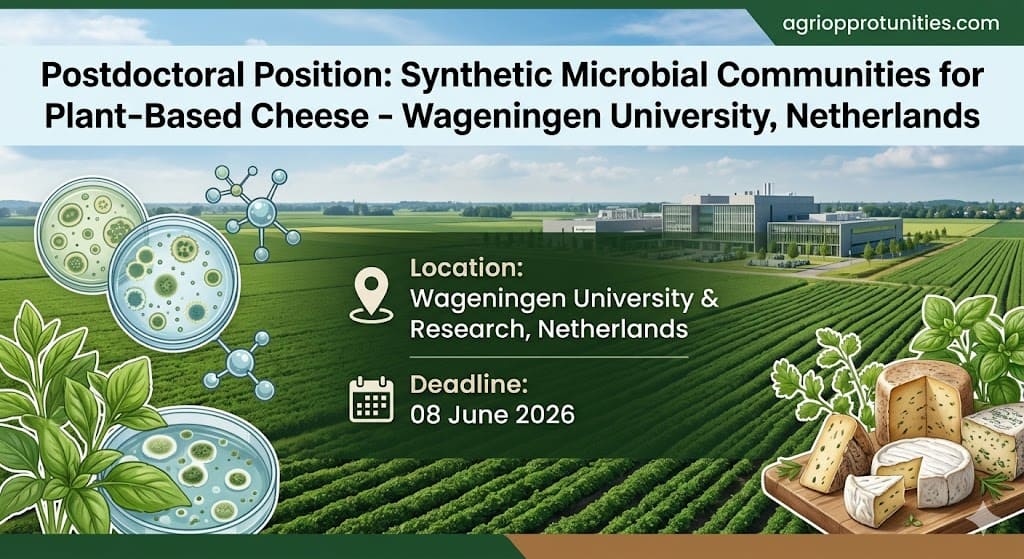
Postdoctoral Position: Synthetic Microbial Communities for Plant-Based Cheese – Wageningen University, Netherlands

About Wageningen University & Research
Applications are open for a Postdoc Synthetic Microbial Communities Plant-Based Cheese Netherlands position at Wageningen University. The project explores how spatiotemporal organization of synthetic microbial communities can control flavour and nutritional value of plant-based Camembert. The position is a joint post-doc between the Systems & Synthetic Biology (SSB) chair group, led by Prof. Maria Suarez-Diez, and Food Microbiology (FHM), led by Prof. Marcel Zwietering.
Scholarship Overview
Project Description
As a postdoctoral researcher, you will explore over the next 3 years how we can control the flavour and nutritional value of plant-based Camembert through spatiotemporal organization of synthetic microbial communities (SynComs). Fermentation of protein-rich plant-based substrates could yield cheeses that are both healthy and sustainable. However, optimizing the nutritional value and flavour of such cheese products remains an open challenge.
This project tests the fundamental hypothesis that bottom-up designed SynComs could provide better nutrition and flavour than pure starter cultures, while offering more reproducible products compared to complex starter cultures. Specific attention will be paid to the role of spatial organization of key community members and the role of physicochemical gradients during fermentation.
Why This Postdoctoral Position Stands Out
This postdoctoral position is unique because it combines synthetic microbial ecology with novel food fermentation. Plant-based cheese is a rapidly growing market, but flavour and nutrition remain challenges. This project tests whether bottom-up designed synthetic microbial communities can outperform traditional starter cultures. You will gain experience in solid-state food fermentation, metagenomic sequencing, microscopy, and mathematical modelling. Wageningen University is the world’s leading university in agriculture and food science. For a PhD graduate interested in microbial communities and sustainable food production, this is an opportunity to do research with direct industrial applications.
Key Responsibilities
- Use solid-state food fermentation techniques with diverse (i.e., pure, SynCom, and complex) starter cultures and evaluate flavour and nutrition composition
- Evaluate the spatiotemporal patterns of microbial community assembly and composition using metagenomic sequencing and microscopic techniques
- Develop mathematical models of spatiotemporal organization of SynCom-fermented plant-based cheeses to enable further control
- Work with highly interdisciplinary colleagues in a collaborative environment
- Develop and lead novel research questions, design experiments, analyze and synthesize results, and communicate outcomes at (inter)national conferences as well as publish these outcomes in peer-reviewed journals
Candidate Profile and Eligibility
| Requirement | Details |
|---|---|
| Education | PhD in Microbiology, Food Sciences, Biotechnology, or closely related fields |
| Experience | Hands-on experience with microbial communities, microbial cultivation, and fermentation processes |
| Techniques | Practical experience with chemical analyses and sequencing-based techniques |
| Programming | Experience with programming, modeling of microbial systems, and/or handling complex data sets |
| Language | Strong spoken and written communication skills (English C1 level) |
| Personal Qualities | Proactive, flexible, team-player, connector, enjoys working in different environments |
What They Offer
| Benefit | Details |
|---|---|
| Salary | €3,546 – €5,538 per month (full-time, 38 hours/week) |
| Contract | One-year with extension (up to 3 years) based on performance |
| Year-end Bonus | 8.3% |
| Pension | Excellent pension scheme |
| Parental Leave | Partially paid parental leave |
| Sabbatical | Sabbatical leave and study leave |
| Sports | Sports facilities on campus for a small fee |
| Location | Wageningen, Netherlands (greenest and most innovative campus) |
My Application Tips
- Highlight your microbial community experience – Hands-on work with SynComs, microbial cultivation, and fermentation
- Emphasise both wet-lab and dry-lab skills – The position values candidates with experience in both
- Show programming and modelling experience – Mathematical modelling of microbial systems is a key component
- Demonstrate metagenomic and sequencing skills – Evaluating spatiotemporal patterns of community assembly
- Mention your interest in plant-based foods – Understanding the application context is valuable
Who Should Apply
This postdoctoral position is perfect for a PhD graduate in microbiology, food sciences, or biotechnology who wants to work at the intersection of synthetic microbial ecology and food fermentation. If you are fascinated by how microbial communities can be designed to control flavour and nutrition in plant-based cheese, and have experience with both wet-lab techniques and computational modelling, this position offers training across metagenomics, microscopy, and mathematical modelling. Candidates with experience in SynComs or solid-state fermentation are especially encouraged.
How to Apply
Click on the application button next to the vacancy on the Wageningen University website. Only applications submitted through the website will be considered.
Application Deadline: June 8, 2026
First Interviews: Scheduled a couple of weeks after closure of this position
For more information, contact: dr. Oscar van Mastrigt – oscar.vanmastrigt@wur.nl or +31 6 81172280