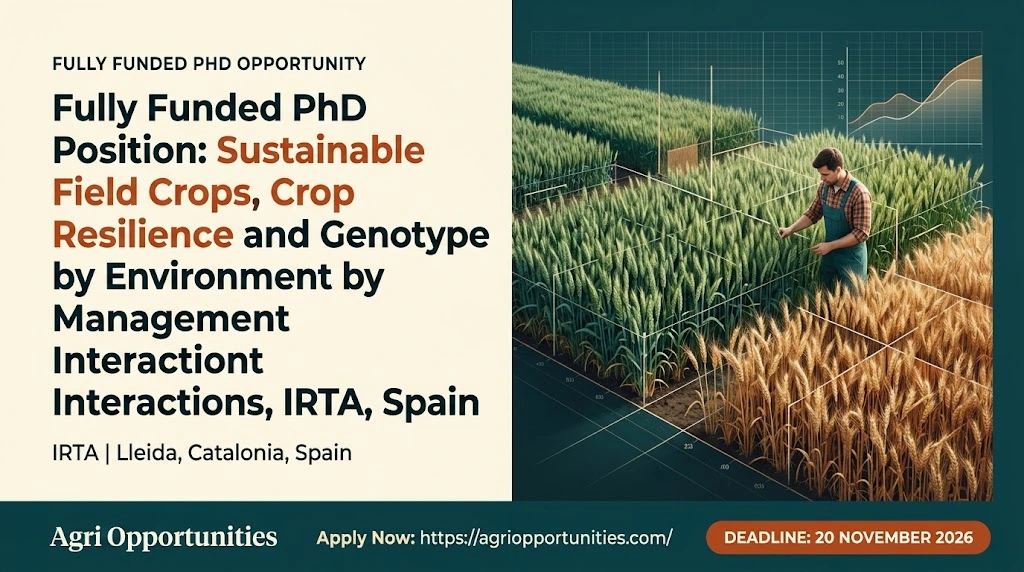
Fully Funded PhD Position: Sustainable Field Crops, Crop Resilience and Genotype by Environment by Management Interactions, IRTA, Spain

Quick Overview
IRTA, the Institute of Agrifood Research and Technology, is hiring a PhD Candidate for its Sustainable Field Crops Program, based in Lleida, Catalonia, Spain. This is a fully funded PhD scholarship embedded in HEROCROP, a Horizon Europe research project on crop resilience.
The project takes an interdisciplinary approach, combining crop physiology, breeding, agronomy, and advanced statistical analysis. The doctoral research will investigate the genetic and phenotypic determinants of crop performance and stability under contrasting environmental and management conditions. Wheat is the principal experimental focus, with opportunities for cross crop collaboration.
The position runs for four years, with a gross annual salary starting at 19,656 euros in the first and second years, rising to 21,060 euros in year three and 26,325 euros in year four. IRTA also pays the doctoral school fees upon enrolment. The working week is 37.5 hours, with Friday afternoons off, and there are 23 vacation days plus additional personal days and remote work allowances.
The application deadline is 20 November 2026, and the contract is expected to start in December 2026.
If you have a master’s degree in agronomy, crop science, plant breeding, or genetics and an interest in quantitative genetics and predictive breeding, this is a strong fully funded agriculture scholarship.
Key Details
| Position | PhD Candidate in Sustainable Field Crops |
| Organization | IRTA, Institute of Agrifood Research and Technology |
| Location | Lleida, Catalonia, Spain |
| Program | PhD, four years |
| Qualification | MSc degree in agronomy, crop science, plant breeding, genetics, plant biology, or a related discipline |
| Funding | Fully funded PhD scholarship, salary plus doctoral school fees covered |
| Salary | 19,656 euros in years one and two, 21,060 euros in year three, 26,325 euros in year four, paid in 14 payments |
| Start Date | December 2026, approximately |
| Deadline | 20 November 2026 |
| Supervisor | Dr. Marta da Silva |
About the Project and Organisation
IRTA is a public research institute in Catalonia, Spain, focused on agrifood research and technology. Its Sustainable Field Crops Program works on crop production systems, breeding, and adaptation to environmental constraints. The program is based in Lleida, an agricultural region in inland Catalonia with a strong field crop sector.
The HEROCROP project is funded under Horizon Europe, the EU’s framework programme for research and innovation. It addresses crop resilience through interdisciplinary studies of plant adaptation, phenotypic variability, and genotype by environment by management interactions. The consortium brings together researchers in crop physiology, breeding, agronomy, and advanced statistical analysis from multiple countries.
The doctoral research will examine the genetic and phenotypic determinants of crop performance and stability under contrasting environmental and management conditions. Wheat is the primary experimental focus, with scope for collaboration on other crops. The work combines field phenotyping, genetic information, and quantitative analysis to assess and predict varietal performance across environments.
The working conditions are notably strong for a European PhD position. The salary is competitive by Spanish standards, and IRTA covers the doctoral school fees. The 37.5 hour workweek with Friday afternoons off, 23 vacation days, and additional personal days reflect a genuine focus on work life balance. The remote work allowance of six days per month adds flexibility.
Key Responsibilities
Experimental Design and Coordination
- Contribute to the design, coordination, and scientific evaluation of controlled and field based experiments
- Address crop responses to environmental constraints and management variation
- Ensure harmonised agronomic and physiological assessment methods across sites
Phenotyping and Characterisation
- Characterise phenotypic diversity and adaptive responses in selected crop genetic resources
- Apply and evaluate field based and high throughput phenotyping approaches
- Describe crop development, performance, and responses to stress
Data Analysis and Modelling
- Analyse genetic, environmental, and management sources of variation in crop performance
- Integrate phenotypic, genetic, environmental, and agronomic datasets
- Develop and evaluate statistical and predictive approaches for varietal performance and adaptation
- Use reproducible research workflows
Collaboration and Communication
- Work with HEROCROP partners on experimental harmonisation and data stewardship
- Evaluate the reliability and transferability of phenotypic and genetic information
- Publish results in peer reviewed journals and present at conferences
- Contribute to scientific interpretation and communication across the consortium
Candidate Profile
Required:
- Master’s degree in agronomy, crop science, plant breeding, genetics, plant biology, or a related discipline eligible for doctoral enrolment
- Strong interest in quantitative genetics, crop physiology, plant adaptation, predictive breeding, or quantitative agronomy
- Ability to organise experimental work, collect reliable data, and interpret research findings
- Good written and spoken English
- Communication and scientific writing skills
- Motivation to learn and apply statistical and computational methods such as R or Python
- Strong teamwork skills and ability to adapt to multidisciplinary environments
Desirable:
- Experience in field trials, experimental design, crop phenotyping, quantitative genetics, genetic marker data, or multi environment experiments
- Familiarity with genomic data analysis, genomic prediction, mixed models, remote sensing, field sensors, or crop modelling
- Knowledge of crop responses to abiotic or biotic constraints and interactions with management practices
- Experience with R or Python
- Catalan and Spanish language skills
What They Offer
| Benefit | Details |
|---|---|
| Position | PhD Candidate in Sustainable Field Crops |
| Organization | IRTA |
| Location | Lleida, Catalonia, Spain |
| Program | PhD, four years |
| Salary | 19,656 euros years one and two, 21,060 euros year three, 26,325 euros year four, paid in 14 payments |
| Doctoral School Fees | Covered by IRTA |
| Workweek | 37.5 hours, with Friday afternoons off |
| Intensive Schedule | From 15 June to 15 September |
| Vacation | 23 days |
| Family and Work Conciliation | 3 days |
| Personal Days | 45 hours |
| Remote Work | 6 workdays per month |
| Work Life Balance | Flexible schedule |
| Training | Continuous training and professional growth opportunities |
| Visa Support | IRTA’s People Department supports non EU candidates with residence and working permits |
Application Tips
- Apply before 20 November 2026. The deadline is firm, and the contract starts around December 2026.
- Send your CV and motivation letter. These are the specified application documents.
- Highlight your quantitative background. The project is quantitative at its core. Mention experience with statistics, R, Python, or mixed models.
- Show any field trial or phenotyping experience. Field trials, experimental design, crop phenotyping, and multi environment experiments are desirable.
- Mention genomic or genetic data experience. Genomic prediction, marker data, or genomic analysis familiarity strengthens your application.
- Address the interdisciplinary nature of the role. The project combines crop physiology, breeding, agronomy, and statistics. Show that you can work across these areas.
- Note your language skills. English is required. Catalan and Spanish are valued but not mandatory.
- Prepare for a curricular assessment and interview. The selection process includes a curricular assessment and interviews with a selection committee. Additional competency tests may apply.
- Understand the inclusion commitment. The first round of the selection process is reserved for candidates with functional diversity, reflecting IRTA’s inclusion policy.
Editor’s Analysis, What Makes This Fully Funded PhD Scholarship Stand Out
Genotype by environment by management interaction research is where crop breeding and agronomy meet, and it is increasingly central to how varieties are evaluated and deployed. This HEROCROP position sits directly in that space, using wheat as the main experimental system while working within a Horizon Europe consortium that spans crop physiology, breeding, agronomy, and statistics. The quantitative core is strong, with mixed models, genomic prediction, and reproducible research workflows forming the analytical backbone. The employment conditions are unusually good for a Spanish PhD, with a competitive salary, doctoral school fees covered, Friday afternoons off, and remote work allowances. The main trade offs are the December 2026 start, which is tight, and the expectation that the candidate is comfortable with both fieldwork and statistical analysis.
Apply Now
Application deadline: 20 November 2026
Approximate start date: December 2026
Frequently Asked Questions
- What is the position? A PhD Candidate position in the Sustainable Field Crops Program at IRTA, embedded in the HEROCROP Horizon Europe project.
- Is this a fully funded PhD scholarship? Yes, this is a fully funded PhD scholarship with a four year contract, competitive salary, and doctoral school fees covered by IRTA.
- Where is the job located? Lleida, Catalonia, Spain.
- What is the qualification requirement? A Master’s degree in agronomy, crop science, plant breeding, genetics, plant biology, or a related discipline eligible for doctoral enrolment.
- What is the salary? 19,656 euros gross per year in years one and two, 21,060 euros in year three, and 26,325 euros in year four, paid in 14 payments.
- How long is the position? Four years.
- When does it start? December 2026, approximately.
- What is the application deadline? 20 November 2026.
- What research will I do? Investigate the genetic and phenotypic determinants of crop performance and stability under contrasting environmental and management conditions, with a focus on wheat, combining field phenotyping, genetic information, and quantitative analysis.
- Do I need to speak Spanish or Catalan? No, these are valued but not required. Good written and spoken English is required.
- Is visa support available? Yes, IRTA’s People Department supports non EU candidates with residence and working permits.
- How do I apply? Send your CV and motivation letter as instructed in the posting.
Related Opportunities
- Fully Funded PhD, Legumes and Nitrogen Cycling, Cranfield University UK
- PhD in Yield Stability and Nutritional Crop Physiology, University of Hohenheim Germany
- Two Fully Funded PhD Positions in Wheat Take-all Disease Research, Rothamsted Research and Partners
Add Agri Opportunities as a preferred source on Google to see latest agriculture scholarship listings first.
Hello Dear sir, i am Zain, from Pakistan, i have complete M.Sc Agriculture Agronomy, University of Agriculture Peshawar, session 2024-2026, i am interested fully funded PhD Scholarship.