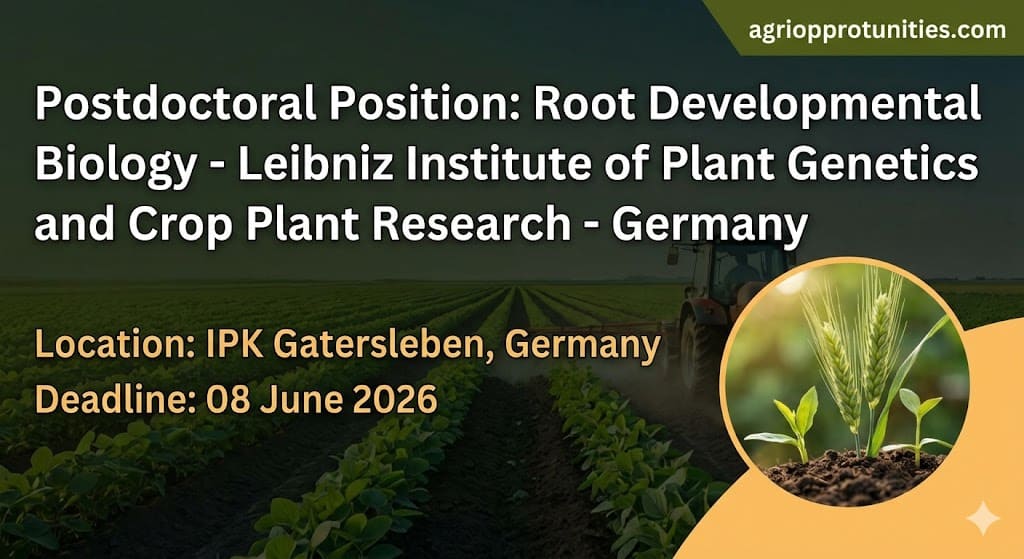
Postdoctoral Position: Root Developmental Biology – Leibniz Institute of Plant Genetics and Crop Plant Research – Germany

About the Leibniz-Institute for Plant Genetics and Crop Plant Research (IPK)
Applications are open for a Postdoc Root Developmental Biology Germany position at the Leibniz-Institute for Plant Genetics and Crop Plant Research (IPK) in Gatersleben. The research focuses on root anatomical and architectural traits in cereals including barley, wheat, and maize. The IPK is a world-class research center with state-of-the-art facilities and scientists from all over the world. The research group Genetics and Physiology of Root Development studies crop root anatomical and architectural traits, mainly focused on cereals including barley, wheat, and maize. The group aims to leverage high-throughput phenotyping to create knowledge about plant function and use forward genetics approaches to unravel the genetic architecture of root traits.
Scholarship Overview
Project Description
The research group studies crop root anatomical and architectural traits, mainly focused on cereals including barley, wheat, and maize. Current projects characterize the function and genetic control of root anatomical and architectural traits to enhance plant stress tolerance. The group uses high-throughput phenotyping and forward genetics approaches to create knowledge about plant function.
Why This Postdoctoral Position Stands Out
This postdoctoral position is unique because it focuses on root developmental biology in major cereal crops (barley, wheat, maize) – crops of global importance for food security. Roots are critical for water and nutrient uptake, yet they are often understudied compared to shoots. Understanding the genetic architecture of root traits can directly inform breeding for drought tolerance and nutrient use efficiency. The position combines modern genetic and genomic methods (QTL mapping, GWAS, RNA-seq, sequencing data) with molecular biology, wet-lab techniques, and root phenotyping including microscopy. IPK is one of Europe’s premier plant genetics institutes. For a PhD graduate interested in crop root biology, this is an opportunity to conduct research with direct applications for improving crop stress tolerance.
Key Responsibilities
- Root phenotyping including microscopy and imaging
- Plant cultivation and physiological measurements
- Molecular biology and genetics including wet-lab techniques and mutant screening
- Report work in scientific journals and oral presentations
Candidate Profile and Eligibility
| Requirement | Details |
|---|---|
| Education | PhD in Plant Science, Crop Science, Genetics, or related field |
| Experience | Experience with modern genetic, genomic, molecular biology, and bioinformatic methods (sequencing data, SNP data, RNA-seq, QTL mapping, and/or GWAS) |
| Skills | Good communication skills, problem-solving skills, willingness to collaborate |
| Personal Qualities | Strong interest in plant genetics and root biology, strong scientific curiosity and motivation, ability to work autonomously and in a team |
| Language | Good English communication skills |
What They Offer
| Benefit | Details |
|---|---|
| Salary | TV-L E13 (100% full-time) |
| Duration | 2 years |
| Start Date | September 1, 2026 or later |
| Location | Gatersleben, Germany |
| Supervision | Close interaction with academic supervisor |
| Infrastructure | Good infrastructure and welcoming work environment |
| Housing | Accommodation in IPK guest house (on request) |
My Application Tips
- Highlight your experience with genetic and genomic methods – QTL mapping, GWAS, RNA-seq, or sequencing data analysis is essential
- Emphasize root biology or cereal crop experience – Barley, wheat, or maize root research is directly relevant
- Show microscopy and phenotyping skills – Root anatomical phenotyping is a core responsibility
- Demonstrate independence and collaboration – The position requires both autonomous work and teamwork
- Include reference number 21/04/26 in your application
Who Should Apply
This postdoctoral position is perfect for a PhD graduate in plant science, crop science, or genetics with experience in modern genomic methods. If you are fascinated by how root architecture and anatomy affect plant stress tolerance, and want to work on major cereal crops (barley, wheat, maize), this position offers training across genetics, genomics, molecular biology, and root phenotyping. Candidates with experience in QTL mapping or GWAS are especially encouraged. The ideal candidate is someone who wants to combine high-throughput phenotyping with forward genetics to understand the genetic control of root traits.tes with experience in bacterial cellulose or essential oils are especially encouraged.
How to Apply
Required documents: Submit online application (specific document requirements not listed but typically include CV, cover letter, certificates)
Reference number: 21/04/26 (must be indicated in your correspondence)
For questions: Kerstin Schweigert – jobs@ipk-gatersleben.de
For scientific questions: Prof. Dr. Hannah Schneider – Tel.: +49 (0) 39482 5506
Important for international applicants: Foreign qualifications must carry out an equivalence test in Germany (ZAB Statement of Comparability): https://zab.kmk.org/en/statement-comparability
Useful Links
Similar Posts
Senior PhD Researcher: Cellular Biotechnology & Genetics – Portugal
Applications are open for a Senior PhD Researcher Cellular Biotechnology Portugal position at the Institute for Agricultural and Environmental Research and Technologies (IITAA) in Angra do Heroísmo, Azores. The role focuses on assisted reproduction technologies and genetic conservation protocols.
Postdoc Researcher Position: Tree-Ring Detection of Tropical Cyclones – Czech Republic
Applications are open for a Postdoc Tree-Ring Tropical Cyclones Czech position at the Institute of Botany of the Czech Academy of Sciences. This is a 1.5-year postdoctoral fellowship within a funded research project focused on tree-ring-based detection of tropical cyclones and climate change.
CAAS Visiting Scholar Programs 2026 – Research in China
Postdoc applications are open for an Ecological Niche Modeling Postdoc position at Université de Montpellier. The successful candidate will join a dynamic interdisciplinary research group working at the interface of ecology and evolution, epidemiology, and global change biology of vector-borne diseases.
Postdoc Researcher Position: Forest Soil Carbon Stock Monitoring – Sweden
Applications are open for a Postdoc Forest Soil Carbon Sweden position at the Department of Soil and Environment, Swedish University of Agricultural Sciences (SLU) in Uppsala. The successful candidate will research how to improve precision and accuracy in forest soil carbon stock estimates.
Postdoc Researcher Position: Biocatalytic Membranes for Plastic Degradation – Portugal
Applications are open for a Postdoc Bone Biology Austria position at the Ludwig Boltzmann Institute of Osteology. This is a 3-year postdoctoral position funded by the Austrian Science Fund (FWF)
Postdoc Researcher Position: in evolution and functional diversity of rubisco in extremophile photosynthetic organisms, Spain
A Postdoc researcher position to investigate evolution and functional diversity of rubisco in extremophile photosynthetic organisms in Spain is now available at Chalmers University of Technology.