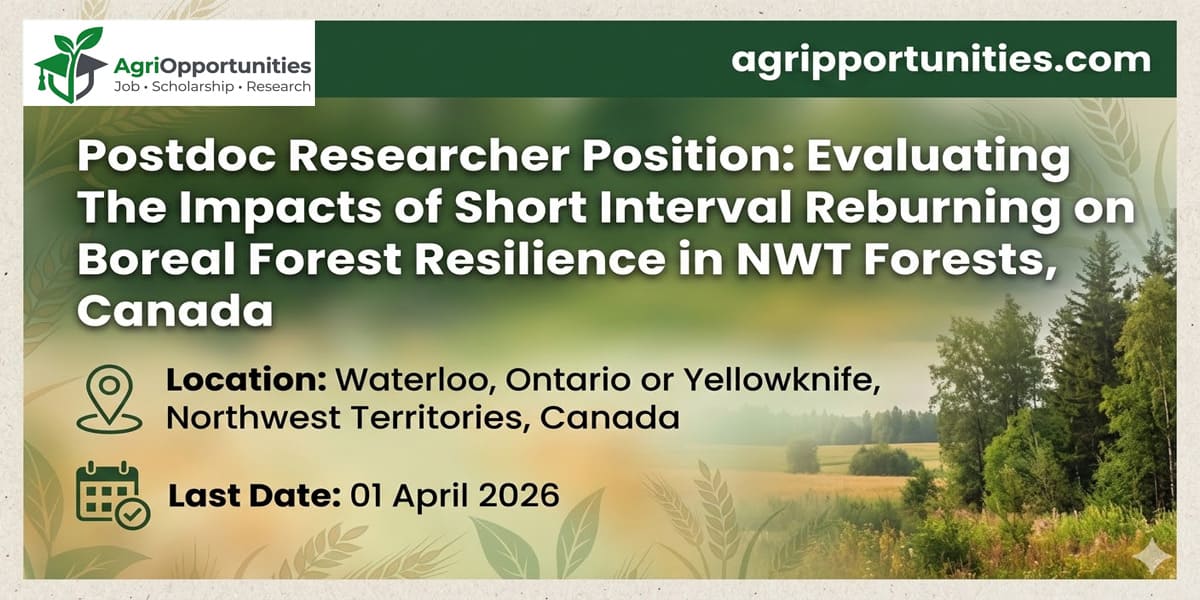
🏛️ Postdoc Researcher Position: Evaluating The Impacts of Short Interval Reburning on Boreal Forest Resilience in NWT Forests, Canada

📚 Background
Applications are now open for a postdoctoral position boreal forest resilience NWT focused on evaluating the impacts of short interval reburning.
The year 2023 marked the first time in recorded history that global temperatures exceeded 1.5°C above pre-industrial averages. International climate change mitigation agreements aim to limit warming to this level. Yet this goal is already unachievable.
The Canadian fire season associated with this temperature exceedance shattered previous records. Consequently, we cannot understate the urgency of preparing for and adapting to this best-case climate warming scenario. Preparing for subsequent 2023-like fire seasons is equally critical.
The Northwest Territories (NWT) was one of the hardest hit parts of the country in 2023. During this time, 70% of the population evacuated. Communities lost structures. Transportation corridors closed, and communications remained offline for considerable periods. Fire behavior surprises also emerged, creating implications for community and firefighter safety.
🎯 Position Overview
📝 About the research project
Recently burned areas have historically slowed or stopped fire advance. However, this was not always the case in 2023, which created additional risk. Fuel buildup around communities compounded this phenomenon. Such buildup resulted from a history of fire suppression that has led to longer fire-free intervals.
To keep NWT communities safe, we require improved information about:
– How fires burned on the landscape in the past
– How this is changing over time
– What this means for future forest composition and fire risk
– How adaptation of fire management decisions around communities can reduce risk
This project will address these gaps. In doing so, it will support operational fire management decisions and community protection planning.
📋 Job Description
This postdoctoral position boreal forest resilience NWT will lead efforts aimed at evaluating the impacts of severe, short interval reburning that was so widespread in NWT in 2023.
Through this work, the researcher will support an evaluation of a range of attributes that enhance our understanding of changes in ecosystem function. These attributes include:
- Post-fire forest and ground vegetation composition
- Carbon stocks
- Forest structure
- Combustion severity
Data collection will support harmonization with an existing network of sites across NWT. These existing sites have experienced longer fire return intervals. Therefore, this approach will facilitate an evaluation of threshold responses to short interval reburning.
✅ Eligibility Criteria
- PhD in ecology, natural resource sciences, environmental science, or a related field
- Evidence of publishing in peer-reviewed literature
- Experience with boreal plant identification and basic forestry methods
- Experience with statistical modelling in the R environment
- Experience working with community and government partners
👥 Supervision
Dr. Jennifer Baltzer will directly supervise this postdoctoral position boreal forest resilience NWT, ensuring comprehensive support and interdisciplinary insights.
📝 Application procedure
To apply, please provide the following:
• letter of interest
• curriculum vitae (CV)
• example of writing skills (published, peer-reviewed manuscript)
Your letter should clearly indicate how you meet each of the selection criteria and state your earliest possible start date.
Applications will be accepted until a suitable candidate is found.
Please send your application package to:
Jennifer Baltzer
📧 APPLY NOWClicking the button will open your email client with a pre-filled template