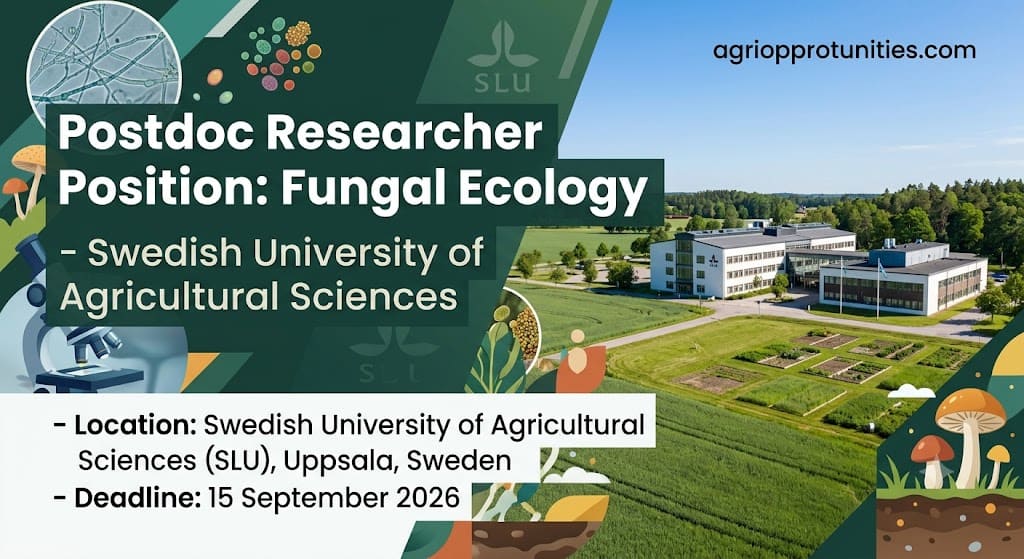
Postdoc Researcher Position: Fungal Ecology -Swedish University of Agricultural Sciences

Quick Overview
Applications are open for a Fully Funded Postdoc in Fungal Ecology at the Swedish University of Agricultural Sciences (SLU) in Uppsala. This 2-year position focuses on CHEGD fungi (waxcaps and allies) – a group of conspicuous fruitbody-forming fungi that are indicators of semi-natural grasslands and of global conservation concern. The project combines mushroom inventories, DNA-barcoding, stable isotopes, genomics, and transcriptomics to advance knowledge of their diversity, distribution, and biology.
Experience Level: PhD in fungal ecology, mycology, microbiology, biology, or related field (within 3 years)
Best Fit: Candidates with interest in fungal ecology, conservation, and molecular methods
Deadline: September 15, 2026
Key Details
| Position | Postdoctoral Researcher |
| Project | CHEGD fungi – diversity, distribution, and biology of waxcaps and allied fungi |
| Location | Swedish University of Agricultural Sciences (SLU), Uppsala, Sweden |
| Qualification | PhD in fungal ecology, mycology, microbiology, biology, or related field |
| Duration | 24 months |
| Start Date | As agreed |
| Deadline | September 15, 2026 |
| Reference Number | SLU.ua.2026.2.5.1-2102 |
| Apply Via | SLU application portal |
| Contact | Karina Clemmensen -karina.clemmensen@slu.se |
Fully Funded Postdoc in Fungal Ecology – Opportunity Overview
The project aims to advance knowledge of the diversity, distribution, and biology of CHEGD fungi (waxcaps and allies) – a diverse group of conspicuous fruitbody-forming fungi that are indicators of semi-natural grasslands and of global conservation concern. In collaboration with citizen scientists, we will map the diversity of CHEGD fungi across grasslands of different management histories based on both mushroom inventories and DNA-barcodes in soils.
This Fully Funded Postdoc in Fungal Ecology position will also attempt to unravel the ecology of CHEGD fungi based on field experiments using stable isotopes, genomics and potentially transcriptomics approaches. The project addresses basic scientific questions while producing information directly useful for improved management and follow-up of a group of threatened fungi.
What You’ll Actually Be Doing
- Developing and executing field experiments
- Laboratory analyses (DNA-barcoding, stable isotopes, genomics, transcriptomics)
- Data analyses and statistical modelling
- Writing scientific papers in collaboration with the project group and external collaborators
- Collaborating with citizen scientists
Fully Funded Postdoc in Fungal Ecology – Research Environment
The Department of Forest Mycology and Plant Pathology at SLU holds a top international position in research. The department focuses on vital interactions between plants, fungi, and other microorganisms in forest and agricultural systems. Key research areas include:
- Forest and agricultural plant pathology
- Plant-soil-microorganism interactions
- Microbial and molecular ecology
- Comparative genomics
- Biological control
Who Should Apply
This position is best for candidates with a PhD in fungal ecology, mycology, microbiology, biology, or a related field awarded within the past three years.
Strong candidates will have:
- Experience with laboratory or field experiments within microbial ecology, fungal biology, or conservation
- Experience with fungal community, genomic, or transcriptomic analyses
- Knowledge of multivariate analyses and statistical modelling
- Excellent communication skills in written and spoken English
- Skills in programming languages (e.g., python, R) – merit
- Fieldwork experience – merit
- Driving licence – merit
Skills That Will Help You Stand Out
| Skill | Why It Matters |
|---|---|
| Fungal ecology | Core research area |
| Field experiments | Data collection |
| Genomics/transcriptomics | Molecular methods |
| DNA-barcoding | Species identification |
| Statistical modelling | Data analysis |
| R or Python | Programming skills |
| Driving licence | Fieldwork |
What They Offer
| Benefit | Details |
|---|---|
| Duration | 24 months (with possibility of extension) |
| Location | Uppsala, Sweden |
| Scope | 100% |
| Research Environment | Top international department |
| Career Development | Career-developing position for junior researchers |
Application Tips
- Highlight fungal ecology experience – Core requirement.
- Emphasize molecular methods – Genomics, transcriptomics, DNA-barcoding.
- Show field experience – Field experiments and fieldwork.
- Demonstrate programming skills – R or Python.
- Include cover letter (max 2 pages) – Describe yourself and your match with the project.
- Apply before deadline – September 15, 2026.
How to Apply
Submit your application through the SLU application portal.
Required documents (in English):
- Cover letter describing yourself and your match with this project (max 2 pages)
- CV describing your education, publications, and relevant work experience
- Copy of certificate of doctoral degree
- Name and contact information for two reference persons familiar with your scientific work
- Deadline: September 15, 2026
- Contact: Karina Clemmensen – karina.clemmensen@slu.se, +46-18-671874
Frequently Asked Questions
- What fungi will I study? CHEGD fungi – waxcaps and allied fungi.
- What is the duration? 24 months.
- Is there fieldwork? Yes, field experiments and collaboration with citizen scientists.
- What methods will I use? DNA-barcoding, stable isotopes, genomics, transcriptomics.
- When is the deadline? September 15, 2026.